.png?width=40&height=40&name=1%20(2).png)


.png?width=40&height=40&name=2%20(2).png)


-1.png?width=40&height=40&name=Group%20(1)-1.png)
%201.png?width=51&height=47&name=Clip%20path%20group%20(1)%201.png)

.png?width=39&height=39&name=Group%20(2).png)
.png?width=34&height=34&name=Vector%20(3).png)


.png?width=1500&height=1500&name=11%20(1).png)


.png?width=1500&height=1500&name=1%20(1).png)

%20-%20Copy.png?width=1500&height=1500&name=2%20(1)%20-%20Copy.png)
%201.png?width=40&height=40&name=Clip%20path%20group%20(1)%201.png)

.png?width=40&height=40&name=Group%20(2).png)

.png?width=30&height=30&name=11%20(1).png)


%20-%20Copy.png?width=30&height=30&name=2%20(1)%20-%20Copy.png)
.png?width=30&height=30&name=1%20(1).png)


The Modern Operating Model of a Heavy-Duty Diesel Repair Shop
Modern heavy-duty diesel repair shops do not run on paper, whiteboards, or end-of-day updates anymore.
They run on real-time visibility, multi-unit workflows, complete technician time capture, built-in compliance, and same-day billing.
Shops still operating like it’s 2015 usually lose billable hours, delay invoices, miss parts, and create downtime they cannot afford.
This post explains what “modern” actually looks like in a diesel shop today, and why older workflows feel harder every year.
The Reality in 2026
Heavy-duty repair has become more complex, not simpler.
Today’s diesel shops routinely handle:
- trucks, trailers, and equipment on the same job
- fleet PM schedules tied to uptime expectations
- DOT inspections and DVIR defect tracking
- serialized parts, cores, and warranties
- technician shortages across the U.S. and Canada
At the same time, many shops are still trying to operate with paper repair orders, whiteboard schedules, spreadsheets for inventory and PM tracking, or generic auto repair software that was never designed for diesel work.
That mismatch is where money leaks out.
Unplanned downtime is a major driver. Industry research from Platform Science shows that unplanned vehicle downtime costs fleets an average of $448 to $760 per vehicle per day, depending on operation and duty cycle. In construction, agriculture, and oilfield work, the real cost is often higher because a single downed unit can idle an entire crew.
Every hour matters.
What “Modern” Actually Means in a Diesel Shop
Modern does not mean flashy software.
Modern means:
- you can see what is happening right now
- jobs move without constant babysitting
- technicians spend time fixing trucks, not filling out paperwork
- nothing critical waits until the end of the day
In a modern heavy-duty shop, managers know at any moment:
- which jobs are in progress
- which technicians are actively working or waiting
- which jobs are stuck on parts or approval
- what work is ready to bill
Not tomorrow.
Not payroll day.
Now.
How Modern Heavy-Duty Shops Actually Operate
1. Work orders are built fast and stay live
Modern shops build digital work orders from the start instead of cleaning up paperwork later.
Service advisors can build repair orders in minutes, pull unit and fleet history instantly, apply PM templates automatically, and attach inspections, photos, and notes as work happens.
The work order becomes the single source of truth for the job, not a clipboard someone interprets later. Shops using modern heavy-duty work order software reduce admin time and avoid missed labor and parts because information stays current.
2. Scheduling is visible, not guessed
Old scheduling relies on whiteboards, sticky notes, and constant reshuffling.
Modern shops use real-time scheduling and dispatch boards that show technician availability, bay usage, and job status as it changes. When a job moves, everyone sees it immediately.
Technicians know where to go next. Advisors stop firefighting. Throughput improves without adding bays or headcount.
3. Technicians do not fill out paperwork at the end of the day
One of the biggest hidden costs in a diesel shop is lost wrench time.
Across maintenance and heavy industrial operations, studies consistently show that technicians spend far less than half of their paid day actually turning wrenches. Research from Prometheus Group shows that average wrench time is typically only 25 to 35 percent of a technician’s shift. The rest of the day is consumed by indirect work like searching for parts, waiting for instructions, traveling between jobs, or filling out paperwork.
Reliable Plant reports similar findings, noting that many maintenance operations see wrench time below 30 percent, meaning more than 70 percent of a technician’s day goes to non-productive tasks.
For heavy-duty diesel shops, this matters because every lost minute is lost revenue. Modern shop workflows reduce this loss by capturing labor in real time and keeping parts and job status visible.
4. Parts and inventory update automatically
Legacy shops update inventory after the fact, if at all.
Modern shops use real-time inventory management that deducts parts when they are pulled, tracks serialized components and cores, shows inventory across shops and service trucks, and flags shortages before jobs stall.
This eliminates phantom inventory and emergency rush orders that quietly destroy margins.
5. Compliance is built into daily work
In modern diesel shops, compliance is not a separate system.
DVIRs, DOT inspections, and preventive maintenance live inside the same workflow as the repair order, not in a binder or someone’s inbox. DVIR defects attach directly to repair orders, defect correction is tracked automatically, and alerts trigger when inspections or repairs are overdue.
This is not optional. FMCSA regulations require DVIR reports to identify the vehicle and list any defect or deficiency that would affect safe operation or cause a breakdown. When defects are reported, the motor carrier must certify that defects were corrected or that correction was unnecessary.
Modern systems reduce compliance risk by making inspection follow-up part of daily work instead of a last-minute scramble.
6. Managers see problems while they can still fix them
Legacy shops manage from yesterday’s numbers.
Modern shops manage from live dashboards that show when technicians are idle too long, jobs are waiting on approval, parts are holding work up, or completed jobs are ready to invoice.
Problems get fixed the same day instead of appearing in month-end reports.
7. Invoicing happens immediately
In modern shops, labor and parts are already captured by the time work is finished.
Estimates convert to invoices instantly. Invoices go out the same day. Cash flow improves without retyping or chasing paperwork.
Modern vs 2015 Workflows
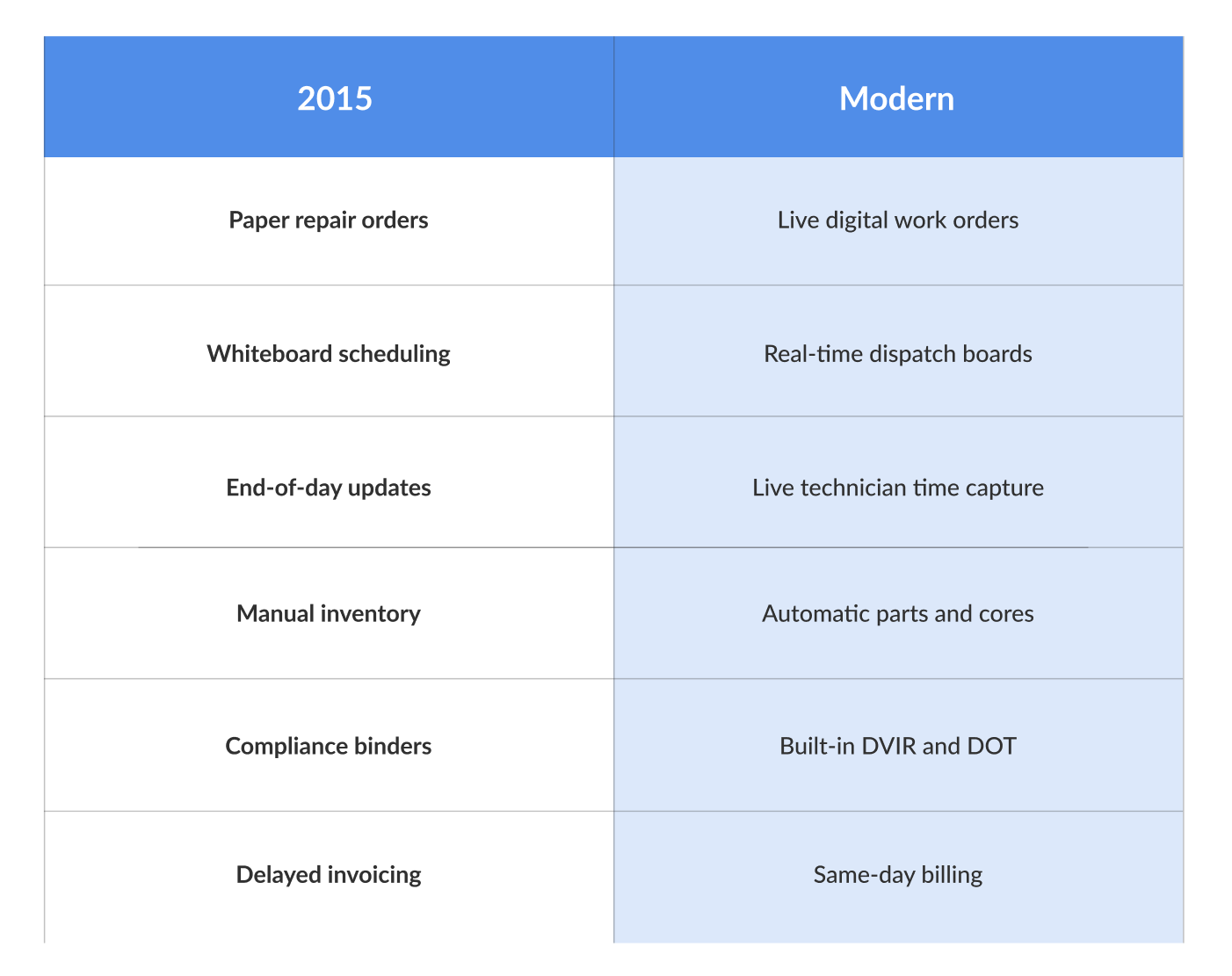
This is not a small upgrade. It is a different operating model.
Why Legacy Software Feels Wrong Now
Legacy systems were not built for fleets, trailers, compliance requirements, mobile technicians, or multi-day diesel jobs.
They force duplicate data entry, hide information, and slow technicians down. That friction shows up as missed labor, delayed billing, admin overload, and frustrated staff.
Even when nothing is “broken,” the shop feels harder to run.
Where ShopView Fits
ShopView exists because diesel shops do not work like car shops.
It is built specifically for heavy-duty diesel repair, fleet maintenance, and trailer and equipment work. It is not adapted from auto software and not designed around consumer repair workflows.
Shops using ShopView typically see faster work order creation, cleaner scheduling, higher labor capture, and clearer operational visibility within the first 90 days.
What “Good” Feels Like
Good feels like knowing where every job stands, knowing what every technician is doing, knowing nothing is slipping, and knowing you are billing for all the work you perform.
Modern shops do not guess.
They see.
Final Word
Heavy-duty diesel repair has changed.
If your workflows have not, you are paying for it every day in lost time, delayed invoices, and hidden margin leaks. Modern shops run on real-time visibility and purpose-built systems.
That is not the future.
That is how the best shops run today.
Book a demo to see how a modern diesel shop actually runs.