Parts Manager Software That Keeps the Right Parts on the Shelf and on the Job
ShopView gives heavy-duty parts managers real-time visibility into every part in inventory - what is on the shelf, what is on a job, what needs to be ordered, and what has been used and billed. No spreadsheets. No sticky notes. No jobs stalling because a part nobody tracked ran out yesterday.
Parts usage connected to work orders
Revenue recovered from missed parts billing
Reduction in parts-related job delays
Trusted by Parts Teams at Heavy-Duty Repair Shops Across North America
Parts managers and parts advisors at diesel, truck, trailer, fleet, and heavy equipment repair shops use ShopView to keep inventory accurate, jobs supplied, and billing complete - without the end-of-day scramble to figure out what went where.




Stop Losing Money on Parts That Were Used But Never Billed
In a heavy-duty shop, parts are one of the highest-cost inputs in every job. When parts tracking is done on paper, in spreadsheets, or from memory, two things happen consistently: parts get used that are never billed to the job, and parts run out without enough warning to reorder before a job stalls.
ShopView connects parts directly to work orders so every part pulled from the shelf is attached to a specific job, tracked against inventory, and included in the invoice automatically. Nothing gets used without being recorded. Nothing gets billed without being accurate. And when stock drops below threshold, ShopView tells you before the problem hits a job.
Inventory Tools Built for Parts-Heavy Heavy-Duty Repair
Real-Time Parts Inventory Across Every Job and Location
ShopView tracks parts inventory in real time as parts are added to work orders, used on jobs, received from vendors, and returned or exchanged. Instead of counting stock at the end of the day and trying to reconcile what happened, your inventory reflects what is actually on the shelf right now. For shops with multiple bays, multiple technicians pulling parts, and high job volume, this live visibility is the difference between knowing you have a part and finding out you do not when a technician needs it.
- Real-time inventory tracking across all parts, locations, and bays
- Parts automatically decremented when added to a work order
- Track cores, returns, vendor credits, and serial number items
- Multi-location inventory support for shops with more than one facility
- Full parts usage history by job, technician, customer, or unit
Connect Parts to Jobs So Nothing Gets Missed at Billing
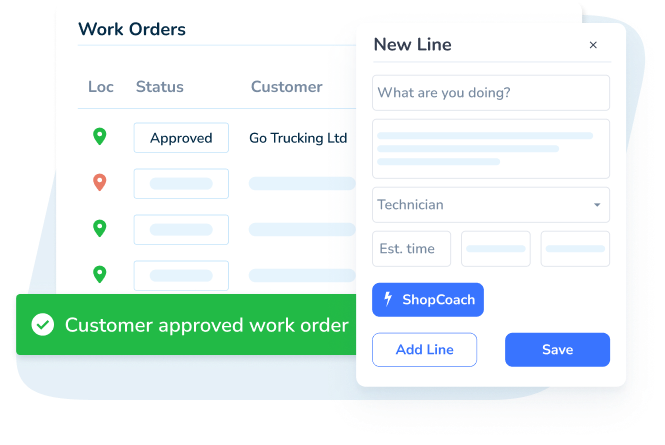
The most expensive parts mistake in a heavy-duty shop is not ordering the wrong thing - it is using the right thing and forgetting to bill it. When technicians pull parts during a repair and those parts are not tied to the work order, they disappear from inventory without generating revenue. ShopView connects parts directly to work orders at the point of use. When a technician requests a part or a parts manager adds one to a job, it attaches to that specific repair order automatically. When the job closes, every part is already on the invoice - no manual reconstruction, no missed items.
- Add parts to work orders from the parts room or the bay
- Parts requests from technicians go directly into the job record
- Every part used on a job is attached and ready to bill at close
- Part costs, margins, and markups are tracked per job
- Catch unbilled parts before the invoice goes out to the customer
Stay Ahead of Stockouts With Automatic Reorder Alerts
A job that stalls because a part ran out costs more than the part itself. Every hour a vehicle sits waiting on a part is a bay that could be generating revenue. ShopView's reorder alerts tell you when stock drops below your defined threshold - before it becomes an emergency. Combined with the IBS heavy-duty parts catalog integration, ShopView gives parts managers a faster path from low stock to purchase order, without switching systems or rebuilding part details from scratch.
- Set custom reorder thresholds for any part in inventory
- Get automatic alerts when stock drops below minimum levels
- Generate purchase orders directly from reorder alerts
- IBS parts catalog integration for fast heavy-duty parts lookup
- Track pending orders and expected arrival against open job needs
What Parts Teams Are Saying
"Coming from another shop management software the change was night and day. Great ease of use, customer service, and tons of new features all the time. We can keep track of everything and have had no issues."
Curtis S.
Parts Advisor, Automotive

"It is easy to use and affordable for our business. We can keep track of all of our customers and have experienced no bugs or issues. The team is always there when you need them."
Damjan A.
Parts Specialist, Retail
"I find ShopView easy to navigate through work orders - from setting up work orders to adding parts, managing inventory with the ability to cycle count to keep inventory up to date, and managing tech times. It makes tracking parts for payroll and billing a breeze."
Kerri W.
Parts Specialist

What Parts Managers See with ShopView
Parts usage tied to specific work orders
Revenue increase from closing parts billing gaps
Fewer job delays caused by parts shortages
Additional monthly billing per technician when parts and labor are fully captured
How ShopView Manages Parts From Shelf to Invoice
Parts Enter Inventory and Are Tracked in Real Time
Receive parts against a purchase order, enter them into inventory, and ShopView tracks them from that moment on. Every unit is accounted for - on the shelf, on a job, on order, or returned.
Technicians Request Parts, Parts Attach to the Job
When a technician needs a part, they request it directly in ShopView. The parts manager fills the request from inventory. The part is automatically attached to the work order and deducted from stock - no separate tracking step required.
Parts Flow Into the Invoice at Job Close
When a job is complete, every part used is already on the repair order. Admin staff generate the invoice with all parts accounted for. Nothing is missed. Nothing needs to be added manually. The billing is accurate from the start.
Parts Management Is a Team Sport
Accurate parts management does not happen in isolation. When the parts team, technicians, service managers, and admin staff are all working in the same system, parts flow faster, billing is cleaner, and nothing falls through the gap between departments.
Shop Owner
See parts costs, margins, and job profitability in real time.
Learn moreService Manager
Track parts holds and job status from the job board.
Learn moreTechnician
Request parts directly from the bay without leaving the job.
Learn moreAdmin Staff
Invoice parts accurately without rebuilding what was used.
Learn moreBuilt by People Who Know What a Parts Room Actually Looks Like
ShopView was built by people who have run heavy-duty repair shops - including the parts side of that operation. We know what it means to track cores, manage vendor relationships, deal with back-ordered injectors, and try to reconcile what came in against what went out on a busy Friday afternoon.
That is why ShopView's inventory tools are built around the reality of heavy-duty parts management, not a generic warehouse model adapted for a repair shop.
Why Heavy-Duty Parts Teams Choose ShopView
IBS Parts Catalog Integration
ShopView integrates with Interstate Billing Service (IBS) - the heavy-duty parts catalog used by truck and trailer repair shops across North America. Look up parts, pull pricing, and add them to work orders without switching systems or re-entering part numbers.
Connected to Every Work Order
Parts in ShopView are not managed in a separate inventory module that talks to the shop system. They are built into the same workflow as work orders, technician tracking, and invoicing - so every part used on every job is visible, tracked, and billable from one place.
Support That Understands Heavy-Duty Parts Operations
Get help from a team that knows the difference between a core charge and a restocking fee, understands multi-vendor parts sourcing, and can help you set up inventory workflows that match how your parts room actually runs.
The Complete Guide to Parts Manager Software for Heavy-Duty Repair Shops
Parts management is one of the most underestimated functions in a heavy-duty repair shop. Get it right, and jobs move, technicians stay productive, and billing is accurate. Get it wrong, and the whole operation slows down - jobs stall waiting on parts, inventory counts drift away from reality, and revenue leaks out of every job where a part was used but not billed.
Parts manager software built for heavy-duty repair is not a warehouse tool with a repair shop skin. It is a system designed around how parts actually move in a diesel, truck, trailer, fleet, or heavy equipment shop: fast, high-volume, job-specific, and often involving expensive, hard-to-source components.
What Is Parts Manager Software for Heavy-Duty Shops?
Parts manager software for heavy-duty repair shops is a platform that gives parts managers and parts advisors real-time control over inventory - tracking parts from receipt through job use through billing, with visibility at every step.
A strong heavy-duty parts management system helps parts teams:
- Track parts inventory in real time across all locations and jobs
- Connect parts usage directly to specific work orders
- Monitor stock levels and get alerts before shortages affect jobs
- Generate and track purchase orders for replenishment
- Manage cores, returns, exchanges, and vendor credits
- Pull parts costs and margins into job-level profitability reporting
- Integrate with heavy-duty parts catalogs for fast lookup and pricing
How Equipment Shop Management Connects Parts to Profitability
Parts are not just an operational concern - they are a profitability lever. In a heavy-duty repair shop, parts margins can represent a significant portion of total job revenue. When parts are tracked accurately and billed completely, those margins protect the shop's bottom line. When they are not, they evaporate.
ShopView gives shop owners and parts managers visibility into parts margins at the job level - what was bought, what was billed, and what margin was captured. This reporting makes it possible to identify which job types, customers, or part categories are generating healthy margin and which are not, and to make pricing and operational decisions based on real data instead of estimates.
Heavy-Duty Truck and Trailer Parts Management: What Makes It Different
Managing parts for heavy-duty truck and trailer repair is more complex than managing parts for a light-duty or passenger vehicle shop. Parts are larger, heavier, more expensive, and often harder to source. Lead times can be significant. Cores have to be tracked and returned. Warranty claims require detailed documentation. Fleet customers may have specific OEM requirements.
ShopView's inventory tools are built for this environment. Serial number tracking, core management, multi-vendor sourcing, and job-level parts history are all part of the system - not add-ons. Parts managers working on truck and trailer repairs get the depth they need without having to build workarounds in spreadsheets.
Equipment Dealer Management Systems: What Parts Managers Should Expect
Equipment dealer management systems and heavy-duty shop management platforms often overlap in their parts management capabilities - but they serve different operational contexts. A dealer management system (DMS) is typically built around the sales and warranty side of equipment operations. A shop management system built for independent repair shops prioritizes job-level parts tracking, technician integration, and billing accuracy.
For independent heavy-duty repair shops, fleet maintenance operations, and dealer service departments that do significant repair volume, the most important parts management capabilities are:
- Real-time inventory tracking connected to work orders
- Automatic parts billing through the repair order workflow
- Reorder alerts and purchase order management
- Parts catalog integration for fast lookup and pricing
- Core and return tracking with vendor credit management
- Multi-location support for shops with more than one facility
- Reporting on parts usage, margins, and job-level profitability
ShopView delivers all of these in a platform built specifically for the repair side of heavy-duty operations.
How to Reduce Parts Shortages in a Heavy-Duty Shop
Parts shortages are almost always predictable in retrospect. A part that runs out was usually on a declining trend for days before it hit zero. The problem is that without a system tracking inventory in real time and alerting the parts manager to low stock, that trend is invisible until it becomes a problem.
ShopView's reorder threshold and alert system makes shortages predictable and preventable. Parts managers set minimum stock levels for the parts they use most. When inventory drops to that level, ShopView generates an alert before the shelf is empty. With the IBS catalog integration, creating a purchase order from that alert takes minutes, not a trip to a supplier website and manual re-entry.
Choosing Parts Management Software as a Parts Manager
If you are the parts manager evaluating shop software, or a shop owner choosing a system your parts team will actually use, these are the questions that matter most:
- Does inventory update in real time when parts are added to a job?
- Are parts automatically connected to work orders, or does it require a separate step?
- Does the system track cores, returns, and vendor credits?
- Can I set reorder thresholds and get alerts before stock runs out?
- Does it integrate with IBS or other heavy-duty parts catalogs?
- Can I see parts margins at the job level, not just as an aggregate?
- Does it support multi-location inventory for shops with multiple facilities?
- Will billing be accurate at job close without manual parts reconciliation?
ShopView answers yes to all of these. It is built for the specific demands of heavy-duty parts management - not adapted from a general inventory tool.
Frequently Asked Questions
Ready to Stop Losing Money on Parts That Were Never Billed?
Join heavy-duty repair shops using ShopView to track every part from the shelf to the job to the invoice - with real-time inventory, automatic reorder alerts, and parts billing that is accurate from the start.