
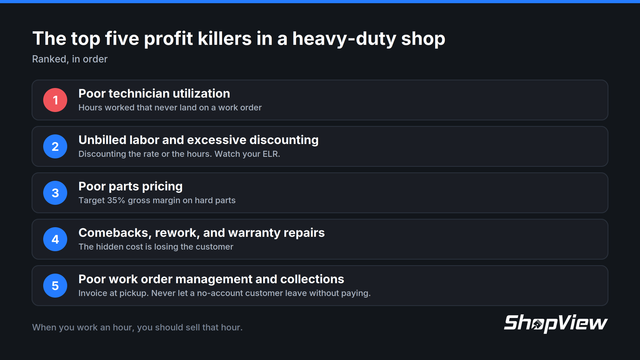
I've talked about this before and I thought I'd put it in an article to make it a little easier and simpler to read, so this one is going to laser focus on the top five things that kill profit in a heavy-duty shop, and I'm going to go through them in order:
- Poor technician utilization
- Unbilled labor and excessive discounting
- Poor parts pricing
- Comebacks, rework, and warranty repairs
- Poor work order management and collections
Every one of these is profit leakage, and you don't need more trucks in the door to fix a single one of them, you just need to stop the bleeding on work you're already doing.
1. Poor technician utilization
And what does that mean? It means the technician is not fully utilized on a work order. So if a technician works an eight-hour day and all eight hours of that day are on work orders, that's 100% utilized, and if they've got two hours a day that are not on work orders and six hours a day that are, that's 75%.
This is the number one profit killer in a shop. It's the number one stat we see lots of shops not looking at, and when we dive into these numbers with them, for one, most shops don't even know the number for their own shop, and when we dig into it with them they find out they're sitting at 70 or 80%.
The entire primary function of the business is you work one hour, you sell that hour. So if only 80% of your hours are on work orders and you're only billing out 80% of your time, that's disastrous for the profitability of the business. When you work an hour, you should sell that hour, period. If your technicians work eight hours, you should be trying to sell eight hours.
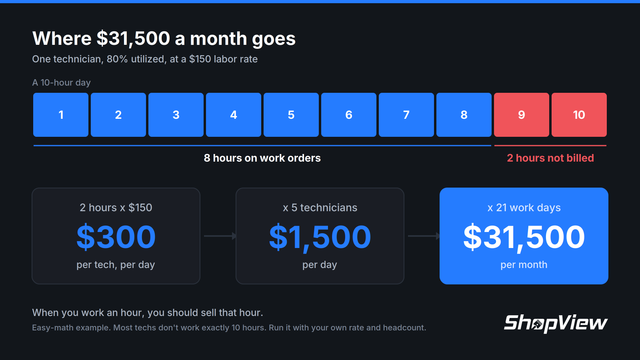
Let's put a number on it. Say a technician works 10 hours a day, and I know technicians don't quite work 10-hour days, lots do, it's just for easy math, and they're 80% utilized, so 20% is not on a work order. That two hours a day, if you multiply that by a labor rate of, let's call it $150 an hour, that's $300 a day per technician, and if you have five technicians that's $1,500 a day, and when you multiply that by 21 work days in a month you're at $31,500 a month.
And that money doesn't leave in one chunk, it goes out in little pieces all day long. A tech standing at the front desk asking what's next, a guy waiting on a part that should have been staged before he started, somebody clocking off for fifteen minutes between every job. Nobody notices any one of those. Stack that up across a whole team...
You can't fix a number you don't track, so every billable tech needs to be clocking in on the computer and clocking onto a work order on every single job, because in a lot of shops 30 or even 40% of a technician's time is not even clocked onto a work order at all.
The target is 100%, and that's achievable, but only if the shop is busy, the bays are planned, and the parts are staged before the job starts. If planning the day is where you're losing it, I wrote about how to schedule technicians already.
2. Unbilled labor and excessive discounting
This is very, very common, and it usually shows up as the business matures and the owner isn't doing all the invoicing anymore, so service advisors come in and start doing the invoicing for him, and the service advisors take the easy way out and they start discounting. Whether they're discounting the rate or they're discounting the hours, they start discounting the work orders, and either way the work got done and you didn't get paid for all of it.
That's why effective labor rate matters, ELR, because it helps you identify if any discounting is happening. If they're discounting the rate you'll see the ELR come down, and if they're discounting the hours you'll see the ELR come down, so you don't have to go read every invoice, you watch that one number.
See it running in a real shop
Book a 20-minute walkthrough and we'll show you how scheduling, parts, and time tracking work together in ShopView.
Book a DemoUnbilled labor is the quieter version of the same thing, hours that got clocked onto the work order and then never made it onto the invoice. The target there is 100% of hours invoiced. Some people think that's a lot. It is achievable, we see a lot of different shops doing it.
And this stacks on top of number one, because a shop will go look at their invoicing efficiency and say hey, we're invoicing 90%, but then you dig in and their utilization is 80%, so they're only billing 90% of that 80%, and in reality that ends up being about 72%.
3. Poor parts pricing
A good average gross parts margin for a heavy-duty shop is 35%. You want to see 35% or higher, and if you're between 30 and 35 that's still okay, but as a target for your shop, something you should be trying to achieve, it's 35 plus. If you're in the 20s there's real work to do.
And this is on your main hard parts. There's obviously exceptions, if you're doing lots of big engine work or dealer engine components or factory parts from the Caterpillar dealership you're not going to get those margins on that stuff, but on standard hard parts for general repairs, using aftermarket or a mix of aftermarket and OEM, you should be able to hit 35%.
When a shop is doing a hundred thousand dollars a month in parts, the difference between a 20% margin and a 35% margin is fifteen thousand dollars a month of profit in your pocket, and $15,000 times 12 is $180,000 a year, on the same parts you're already selling.
Where low parts margin comes from a lot of the time is one generic price matrix and a whole lot of manual overrides on top of it. Use more than one. Set up separate matrices by category, dealer engine parts, aftermarket brake and chassis, a discounted turbo line, whatever makes sense for your mix, and If your advisors are overriding the matrix all the time, the matrix needs work. You shouldn't need to overrid ethe matrix very often if the matrix is doing it's job.
4. Comebacks, rework, and warranty repairs
A high level of comebacks, rework, and warranty repairs is a killer, not only to your customer relationships but also the cost of doing those repairs over again.
The biggest hidden cost to comebacks isn't the comeback itself, but it's the potential loss of the customer. You lose trust with the customer when you have a high comeback rate, and when you lose the customer completely because they had to come back too many times, that's the biggest loss of profit, bigger than the initial comeback cost itself.
So make sure you're doing quality repairs, do the job right the first time, and do a proper quality control process at the end of every repair before the unit goes back to the customer so you minimize your comebacks.
5. Poor work order management and collections
This one covers everything between finishing the repair and the money landing in your account, so managing the work order appropriately, communicating with the customer, making sure the repair gets done on time, and invoicing it when the customer picks up the unit, not a week or two late.
We see it over and over and over again, where we go through a shop's list of work orders and they've got work orders that are three months or four months old with labor and parts on them and they never invoiced them. You gotta get those invoiced.
How does your shop stack up?
See how many billable hours and how much profit you could recover with the right system.
Take the Shop AssessmentThe fix isn't complicated, every week you pull your five oldest open work orders and you make a plan to close each one, or you have the team report them up to you, and you keep doing it after the list is clean because that weekly review is the thing that keeps it clean.
The invoice should get created at the time the customer comes to pick up the unit, and if you're not able to do that every single day, make sure at minimum there's a weekly invoicing push so you close your invoices, because you do not want to extend the receivables to that customer for any longer than needed.
Never let a customer without an account leave without paying
That should be a standard policy in your shop. No service advisor should ever let a customer leave without paying if they do not have an account, and honestly this should be a fireable offense in your company.
Think about it this way. If a customer doesn't pay a $20,000 bill, that's $20,000 out of your pocket, and if your company makes 20% net profit you have to go and do $100,000 worth of work to get that money back, and at 15% net it's over $130,000 worth of work. For one invoice.
Stay on your collections
And the customers who do have an account, stay on your collections with them. Set your credit terms, follow up with your customers, and don't let your customers extend their credit terms on you.
Make it easy to pay, too. ShopView Payments takes card and ACH payments inside ShopView, and the customer portal lets fleet customers review and pay invoices online.
The weekly profit check
You don't need a wall of KPIs to catch any of this, you need a handful of numbers that you pull once a week, per location if you've got more than one, and that you actually look at.
- Utilization, per tech. Target: 100%.
- Hours invoiced against hours on work orders. Target: 100%.
- Effective labor rate against your posted labor rate. A gap means someone is discounting.
- Gross parts margin on hard parts. Target: 35% or better.
- Comebacks this week, and whether each repair had a QC check before it left.
- Your five oldest open work orders, each with a plan to close it.
- Customers without an account who left without paying. Target: zero.
- Account customers past their credit terms.
Get the next guide in your inbox
One useful thing, about twice a month - real numbers, shop stories, and free tools. Short enough to read between jobs.
The pushback I hear, and what I'd say back
"100% utilization isn't realistic." I get why people say it, and in a shop where the day isn't planned and the techs are hunting for parts, no, you won't get there, but in a busy shop where the bays are planned and the parts are staged you absolutely can. Same with invoicing. Some people think 100% of hours invoiced is a lot, and we see a lot of shops doing it.
"Our parts margin is lower because of the work we do." That might be true. If you're doing lots of big engine work or dealer engine components or factory parts from the Cat dealer, you're not going to get 35% on those, and that's fine. The 35% is for your standard hard parts on general repairs.
"If we stop discounting, we'll lose customers." The number one reason customers leave a heavy-duty shop is communication. And it's not price. If customers are calling you for updates it's because you didn't call them, so call them before lunch, not at 3pm, and when a quote goes from $5,000 to $7,500 because of seized bolts or a failed component, you tell them while the truck is still in the shop, not on the invoice. Get the communication right first.
"Making walk-ins pay before they leave will scare them off." Maybe, but go run the math from number five again, one customer walking on a $20,000 bill costs you $100,000 of work to earn back. If they don't have an account, they don't leave without paying. That's the policy.
The bottom line
Collecting your cash is more important than doing the work itself. You can do all the work in the world, but if you don't collect the cash, you don't have any money left.
And that's exactly the reason we're in this business. We do it out of passion, but we also do it to make money, and these businesses can be highly profitable. Pull your five oldest work orders this week and see what's sitting on them.